

One Afternoon
The image arrived without ceremony, which was perhaps why it lodged so deeply in her mind, a small luminous rectangle in her palm, glowing with the borrowed bodies of a dozen strangers who had decided, in the blue hour of some far-off morning, to walk through their own landscape as if they were the landscape and not merely creatures moving across it. They stood there in the photograph, half-dissolved into mist and bare tree, unashamed, almost casual about it, the way a river is casual about being water. Sharleen stared at them for a long moment, her thumb hovering over the glass as though it might be warm, and then she clicked away with the quick, guilty motion of a woman who has been caught reading someone else's letter. She told herself she had not been staring; she told herself there was nothing to see but people, and that people were only ever people. The image, however, did not respect her tidy conclusions. It sat in the back of her mind all day like a stone in a shoe, small, persistent, impossible to ignore, and when the next morning came, pale and reluctant as it always did over their little village, she found herself thinking about it with an attention that felt almost clinical, almost scientific: what would it actually be like? Not the idea of it, which was abstract and harmless, but the fact of it, the weight of air on skin that had never been permitted to meet air alone.
She put on her boots without quite knowing she intended to go anywhere, and by the time she realized what her feet were doing they were already carrying her up the lane toward the hills, those long green shoulders of the world that rose behind the village like the back of some sleeping animal. The hills belonged to an old woman, Máire, everyone called her, though Sharleen had known her as Nana since before she could walk properly, who had known her when she was a small red-headed thing no taller than a gatepost, and who was now so far gone into age that moving about seemed to cost her something like a physical debt. She rarely left her little cottage; the stairs alone were an expedition, and the world beyond its door had grown, in Máire's eyes, into a country she could no longer afford to travel. And yet here was Sharleen, climbing toward the high ground where the dry-stone walls ran in crooked sentences across the grass, confident, utterly, naively confident, that she would be alone up there. The hills were empty; they had always been empty; who else would climb this far for nothing? She did not stop to consider that "nothing" was precisely what an old woman with too much time and too little company might be looking for.
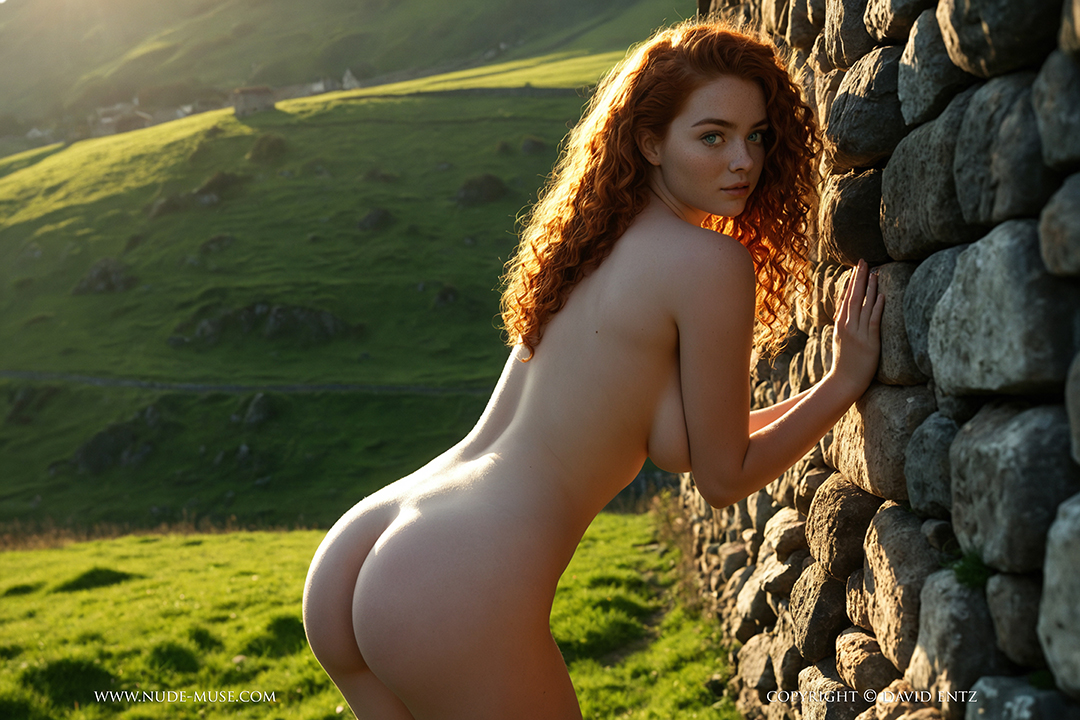
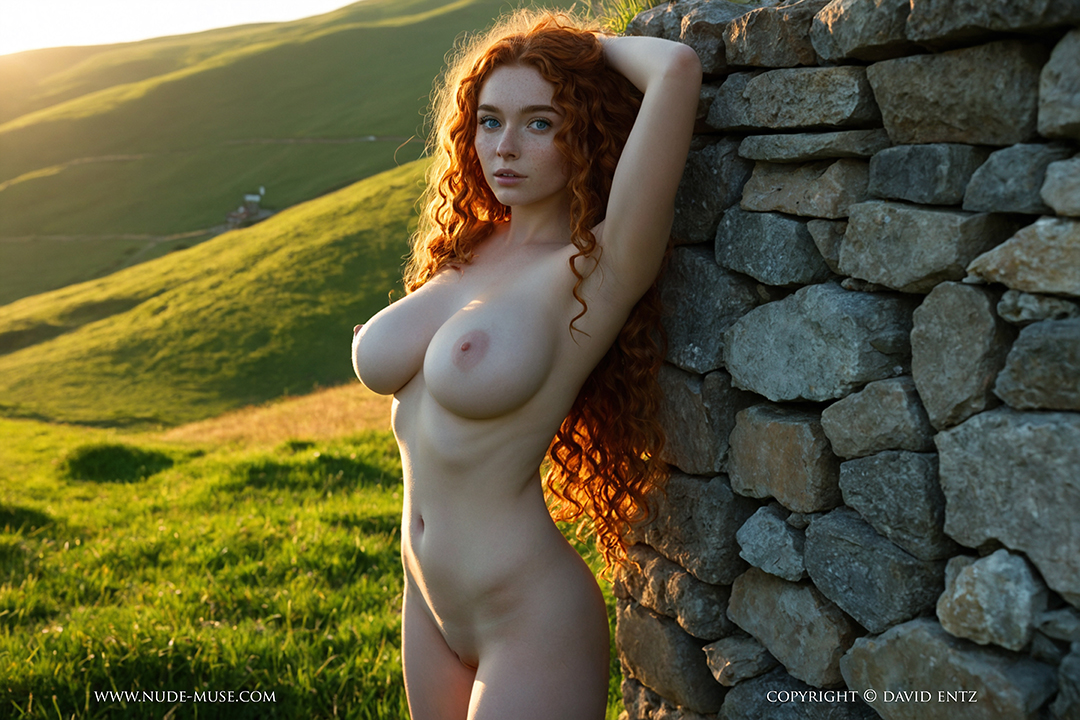
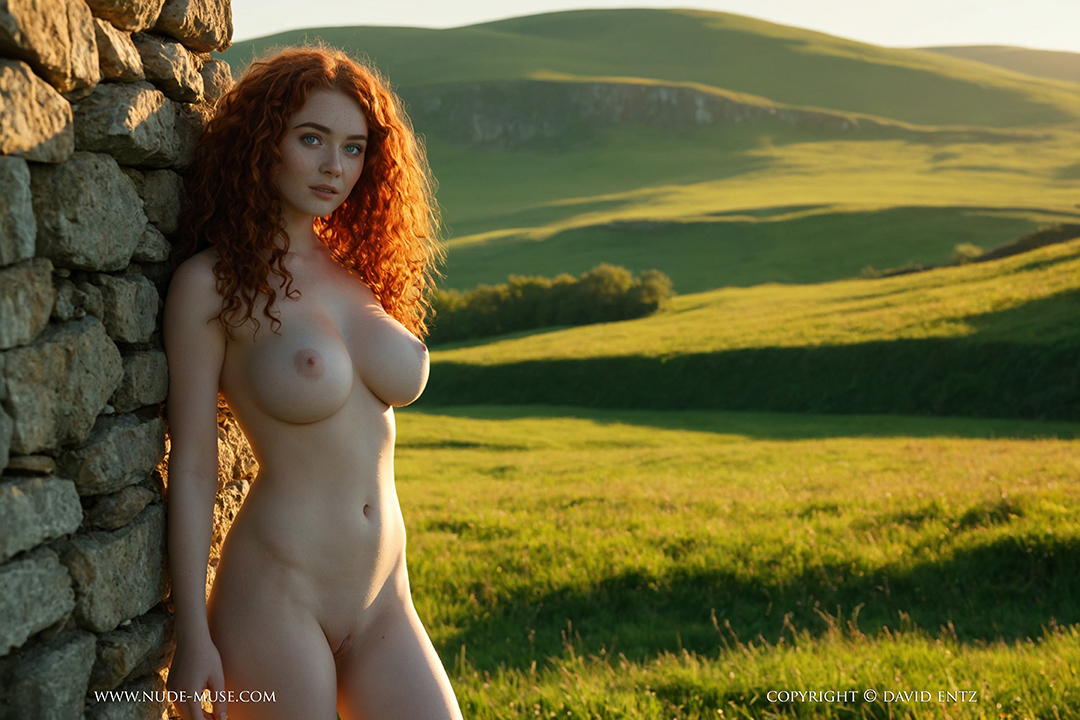
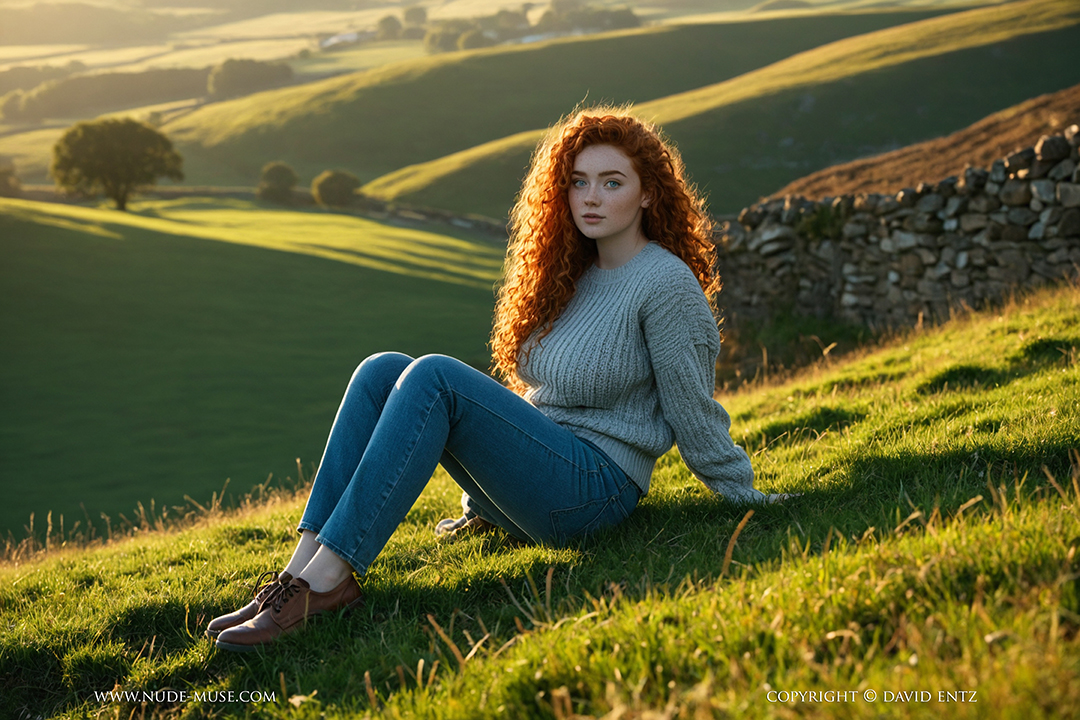
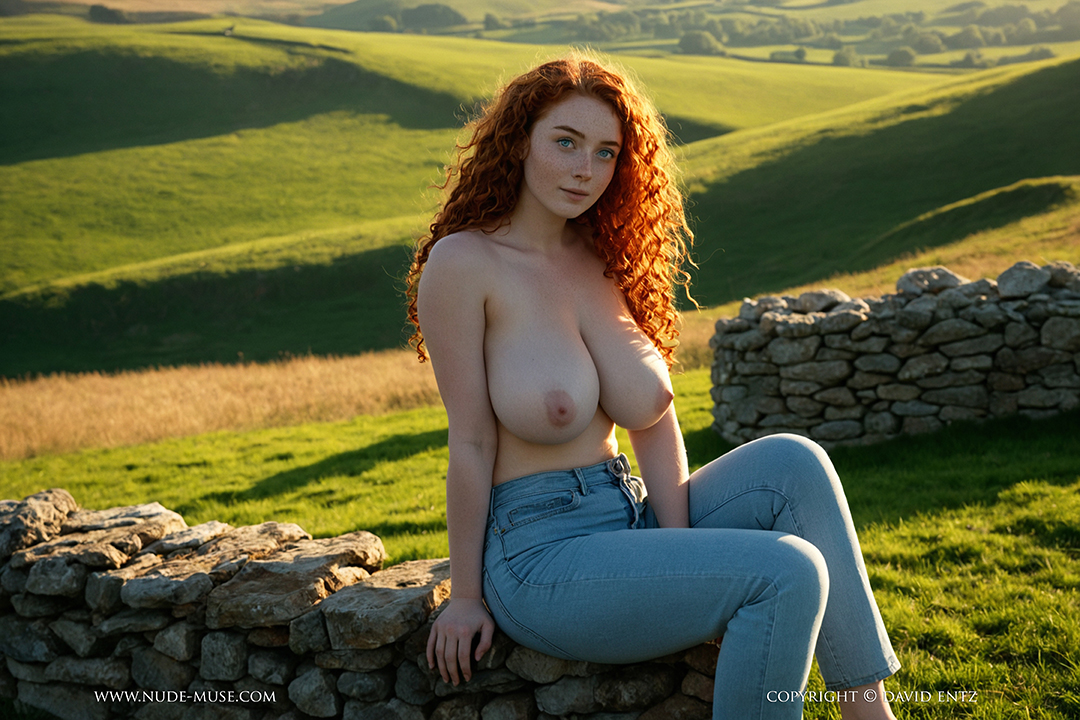
At the top of a long slope, where the grass thinned and the wind acquired a voice, she found her wall, a low, lichen-flecked rampart of stacked stone that ran along the crest like a broken jawbone, and she stopped beside it and simply stood there in the late afternoon sun, which lay across her face in a warm, slanting sheet and turned her freckles to gold. She closed her eyes. She breathed. And then, with the careful deliberation of a person defusing something that might explode, she began to undress.
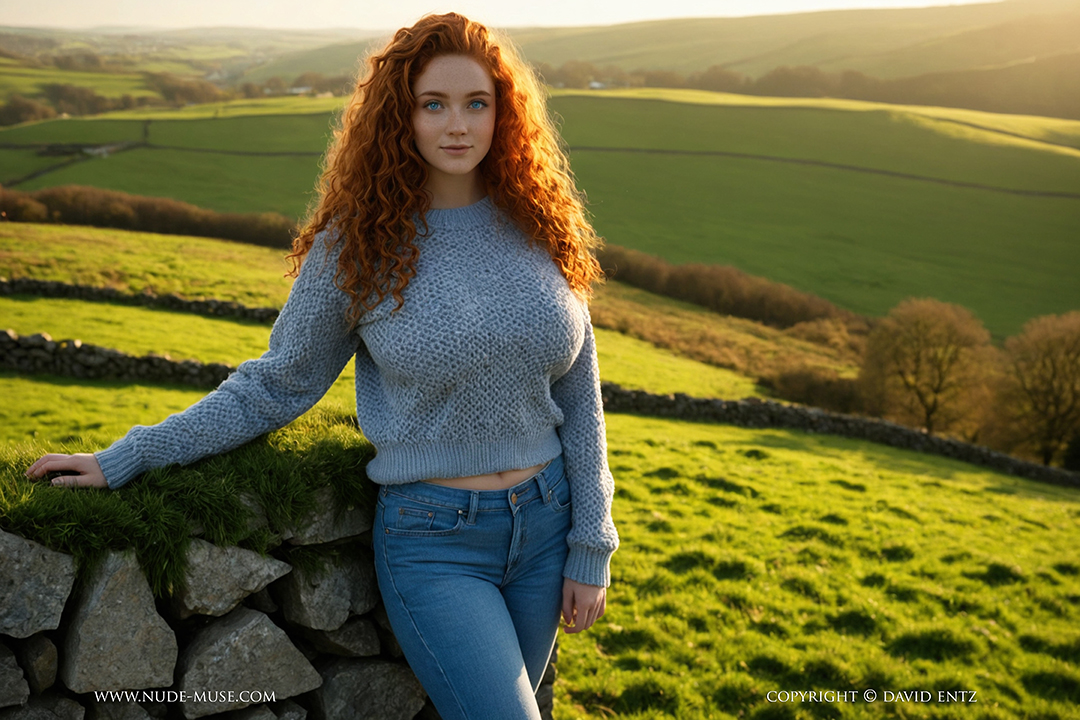
The sweater came off first, that grey, heavy thing she had been wearing so long it had calcified into identity, so that removing it felt less like taking off a garment than like shedding a small, soft skin. Then the jeans, with their rustle and their cold metal button, each fastener a tiny surrender. She peeled them away and stood in her underwear, and there she halted, caught mid-gesture, one hand still raised as if to cast off the last of it, and for a long, trembling minute she simply could not do it. The final two pieces were not merely fabric; they were the last thin walls between the woman and the world, and to drop them was to step off a ledge without knowing whether there was ground below or only air. Her heart hammered against her ribs like a fist against a door. She looked out over the green folds of the hills, all that rolling, empty distance, and waited for permission from a sky that had no ears.
Then, unbidden, unexplained, a courage she did not recognize as her own rose in her chest like heat from a buried fire, and she finished what she had started. The bra came off with a soft exhale of relief; the panties followed, and were dropped to the grass, and Sharleen stood there wholly, completely, irrevocably bare, and the world did not end. It brightened. The afternoon light found the places no light had ever been permitted to find, the soft summit of one breast, the hollow beneath the navel, the long curve of a hip, and laid its warm hand there with the patience of something that had waited all her life for this single, ordinary minute. And then the breeze came, cool and faint, and traced every inch of her as it passed, naming each part as it went, so that she became, for one disorienting instant, not a body but a landscape, her own small country, mapped by wind, every field and ridge and hidden valley exposed to the open sky at once. It was wonderful. It was strange. It was exciting in a way that had no name, a giddy, vertiginous freedom that made her laugh aloud into the empty air, and she laughed again because she could not stop, and the sound of it startled a crow from the wall and sent it wheeling up into the gold.
She decided then to walk, to move along the crest for a while, to feel the totality of it, the sheer completeness of being uncovered, every square inch of her answering the air in turn. She walked slowly, hands loose at her sides, and the sensation was so new and so total that she had to keep stopping to simply stand there and let it be true: that she could exist, fully, without a single thread between herself and the world, and that the world would not close over her like water over a stone.
It was while she was standing thus, eyes half-closed, letting the sun do its slow work on her bare shoulders, that the wall, which had been a solid, silent fact for the last several minutes, produced from behind itself a face.
"Is that you, Sharleen?" The voice came out of the stone as if it had grown there, dry and warm and faintly amused. "I haven't seen you in a long time, dear. What have you been up to?"
Sharleen's first impulse was so violent it was almost physical, a lurch of the whole body toward flight, a desire to run down the slope and reassemble herself into a girl who wore clothes and said sensible things and did not stand naked on top of the world like some kind of monument. She managed, instead, to make her legs hold still and her voice come out in a thin, reasonable thread: "Studying," she said, as if the word were a shield. "I've been studying. I want to go to university soon." It was true; it was also, she suspected, the least of what she had been up to, but it was the only thing that sounded like an answer an old woman might accept without her mind catching fire.
And Máire, Máire simply nodded, and went on talking, in that flat, unhurried way of hers, about this and that: the neighbor's goat, the price of potatoes, a grandchild who had finally learned to ride a bicycle without training wheels. She chatted for several minutes, catching up over events that had passed while Sharleen had been elsewhere in her own life, and all the while she did not look at the bare body standing before her; she looked at the face, the eyes, the familiar red hair, as if that were where a person actually lived. Her eyesight, Sharleen thought with a surge of gratitude, it must simply not be what it once was; she can't tell I'm, she can't see any of this. The relief of it was so sharp it almost hurt.
"My girl," Máire said at last, and her voice took on that particular note, the one Sharleen remembered from childhood, the note that meant I am looking at you and I like what I see, "you have done a lot. The last time I saw you, you were just this high." She raised a hand to indicate a level somewhere around her own chest, and smiled. "And you were wearing considerably more clothes back then. But it's the same spirit. I could tell that from across the field, even with my old eyes."
It was only then, only in that single, slow dawning, that the architecture of Sharleen's relief rearranged itself into something far more unsettling and far more wonderful: there was nothing wrong with Máire's eyes at all. The old woman had seen every inch of her from the first moment she rounded the wall; she had simply chosen, with the quiet authority of a person who has outlived most of her excuses, not to acknowledge what she did not need to see. She had looked at the bare body and decided, in that instant, that it was no more remarkable than the grass or the stone or the light, and by deciding so, she had given Sharleen permission to be a person instead of a spectacle.
Sharleen's face went beetroot red, a heat that started at her neck and flooded down into her chest, and she flung an arm across herself in a gesture so belated it was almost comic, trying to close a door after the house had already been given away. Máire laughed; it was a dry, bright sound, like a stone skipping on still water. "It's a bit late for that now, dear," she said. "But don't you worry your head. It's fine. It's all fine. I used to walk these very hills naked myself when I was younger, before the knees went, before everything got so heavy and slow. The hills didn't mind then, and they won't mind now." She patted the top of the wall with a weathered hand. "Come and sit. My back's gone, and you've been standing there long enough to have gone cold in your head if not in your body. Sit down, and I'll tell you about an adventure I had once up here, something you wouldn't believe, and yet it's true."
And so Sharleen sat. She sat naked on the old stone wall in the slanting afternoon sun, beside a woman who was so close to her in spirit, in that same stubborn, unapologetic way of meeting the world head-on, that she found herself utterly captivated, leaning forward as Máire spoke, forgetting for long stretches where her own bare body had gone and what it was doing. They talked. They laughed. The sun dropped lower and lower behind them like a slow coin being spent, turning the grass to bronze and then to shadow, and still they talked, about the adventure, about the village, about the years that had passed between the girl who was chest-high and the woman who stood fully grown in the light, and somewhere in the middle of it all, Sharleen became aware, with a kind of dazed wonder, that she had been naked the entire time. She had not needed her clothes to sit there. She had not needed them to listen, or to laugh, or to be known. The body, it turned out, was not a secret to be guarded but a fact to be shared, and sharing it had changed nothing except that everything had become easier.
"That was a lovely afternoon," Máire said at last, in the same flat, warm voice she used for weather and for potatoes and now, apparently, for epiphanies. "Come back soon, so we can chat some more. It gets lonely up here when I'm cooped up in that cottage of mine, and it was nice, genuinely nice, to just sit and talk to someone who isn't trying to sell me anything or borrow a tool." She paused, and a small, mischievous light came into her old eyes. "Oh, and you can wear your birthday suit again next time, if you like. No need to dress up for company. In fact," she added, with the air of someone making a decision that had been pending for decades, "next time I might just join you in it. My knees'll manage a short walk, and I've a feeling we've both got more stories than one afternoon can hold."
Sharleen thanked her, thanked her properly, with the full weight of a gratitude she could not quite articulate, because what Máire had given her was not kindness exactly but something rarer: recognition, the simple act of seeing and refusing to flinch. And she promised, in a voice that shook only a little, that she would be back in a week's time.
And she did. And then again the week after that. And so it became a thing, a small, secret rite, as fixed and tender as any prayer: the climb up the green slope, the long stone wall catching the late light, the two of them sitting side by side on the cold rock with their bare legs dangling over the grass, a cup of tea steaming between them in a chipped mug that Máire insisted on bringing up from her cottage because "a woman can't sit naked and proper without a decent drink." They talked about everything and nothing; they watched the sun spend itself down to the horizon; and slowly, week by week, the strangeness drained out of it until the nudity was no longer an event but simply a fact, as natural and unremarkable as breathing. The wall became theirs, a place where the body was not a problem to be solved or a secret to be kept but a country to be inhabited, shared, and loved exactly as it was. And in that quiet, golden country of two, set on the back of an old hill that had seen them both bare before they were born and would see them again long after, Sharleen finally understood what the image in her phone had been trying to tell her all along: that to be wholly yourself in front of another person is not a risk. It is the oldest, most ordinary grace there is, the moment the wall stops being a wall and becomes, at last, a place you can sit down together.
Sharleen doesn't have a "models page", but she does have a members only gallery that you can view HERE
Just to be abundantly clear....none of these "women" exist in real life. They are 100% computer generated by Ai. All the Ai "models" are generated to represent "women" who are over 18 years of age.
Join now to see more artistic nude photos